FLORIDA GARAGE DEHUMIDIFIER FEATURES
Know your size? These are the features worth paying for.
30-second priority list:
- Adjustable humidistat — lets the unit cycle automatically.
- Continuous drainage — avoids constant bucket emptying.
- Built-in pump — useful when gravity drainage will not work.
- Auto restart + efficiency — better for hands-off operation.
SIMPLE / LOWER CAPACITY
Waykar 34-Pint
Continuous drainage option
Good model class to compare when your sizing result points lower
See Current Price →EASIER DRAINAGE
BUILT-IN PUMP
Hisense 50-Pint Lift-Up
Pump-assisted condensate removal
Worth comparing when gravity drainage is inconvenient
See Current Price →HIGHER CAPACITY
AEOCKY 80-Pint
More moisture-removal capacity
For more demanding humidity conditions after sizing confirms the need
See Current Price →Capacity comes first. Choose the right size for your measured conditions, then use features like drainage, pump capability, restart and efficiency to narrow the model.
Want the full checklist? The guide below explains which features actually reduce maintenance and which extras are mostly convenience.
Affiliate disclosure: This page contains Amazon affiliate links. As an Amazon Associate I earn from qualifying purchases, at no additional cost to you. See the Affiliate Disclosure.
If you do not know what capacity you need yet, use our Florida garage dehumidifier sizing guide first.
Three different use cases to compare
These are research-based examples, not products Florida Home Lab has personally tested. They represent different capacity and drainage needs rather than a ranking. Verify the exact current model specifications before purchase.
Typical garage capacity
Waykar 34-Pint
34 pints/day · continuous drainage option
A lower-capacity example for garages whose measured size and moisture conditions support this class of dehumidifier.
View on Amazon →Built-in pump
Hisense 50-Pint Lift-Up
50-pint class · built-in pump
The built-in pump is useful to compare when a suitable gravity-drain route is not practical. Confirm hose routing and lift limits in the current manual.
View on Amazon →Higher-capacity example
AEOCKY 80-Pint
Manufacturer-rated 80 pints/day
A higher-capacity example for more demanding moisture conditions. Compare standardized capacity data as well as advertised capacity when evaluating models.
View on Amazon →Amazon links above are affiliate links. Product availability and specifications can change; verify the exact current listing and manufacturer documentation before purchase.
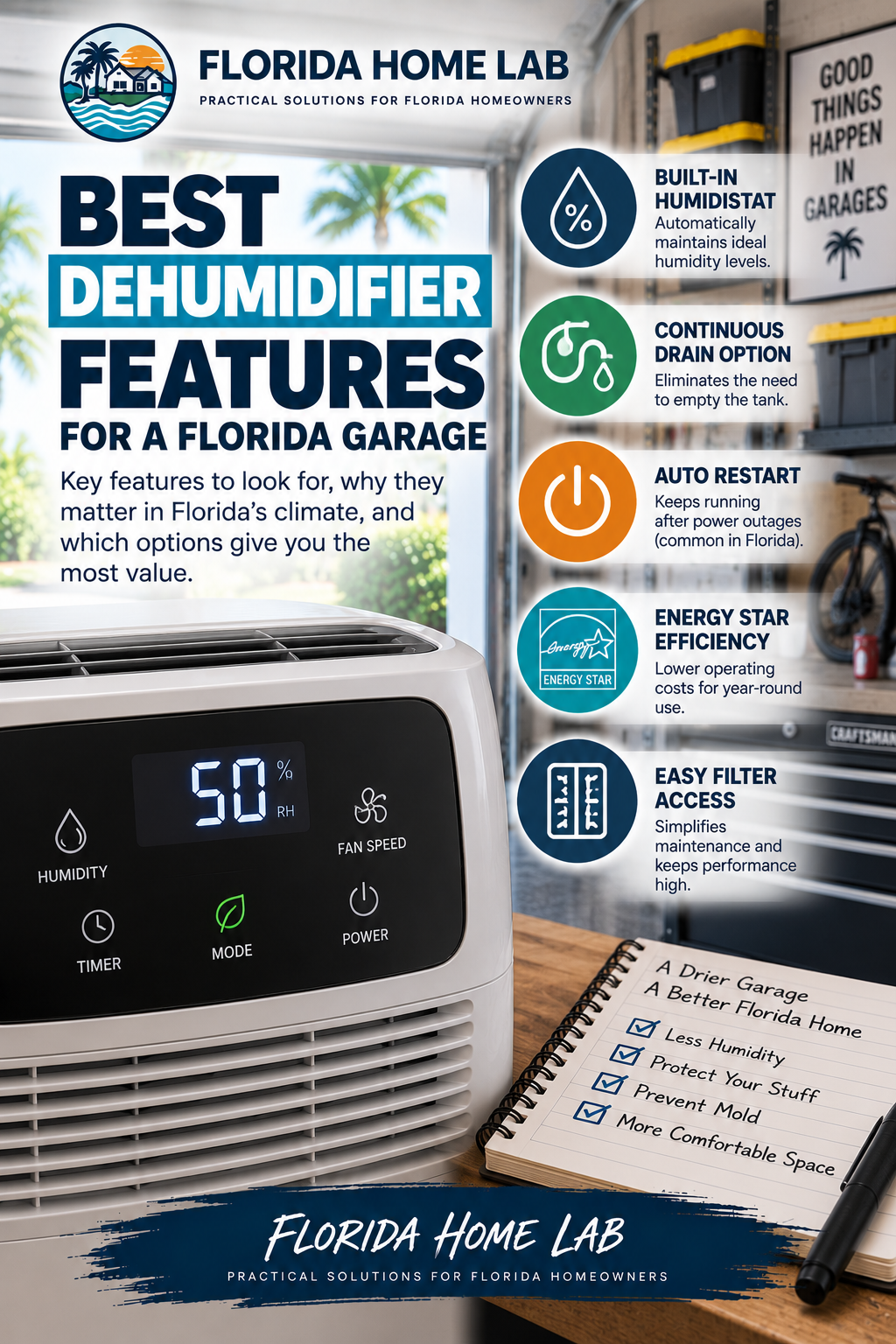
1. Built-in adjustable humidistat
A humidistat lets the unit cycle around a selected relative-humidity setting rather than simply running continuously. ENERGY STAR notes that certified dehumidifiers include a built-in humidistat. Keeping a separate digital hygrometer in the garage also gives you an independent reading.
2. Continuous drainage
A full bucket can stop a portable unit until someone empties it. ENERGY STAR notes that some models can drain through a hose. Where the garage has a safe, manufacturer-approved drainage route, continuous drainage can substantially reduce routine attention.
If gravity drainage is not practical, some models include a condensate pump that can move collected water to an approved drain location. Pump capability, hose routing and lift limits are model-specific.
3. Automatic restart
Check the exact model specifications for automatic restart after a power interruption and for how its settings are restored. This can be useful for equipment intended to operate routinely without constant supervision.
4. ENERGY STAR certification and efficiency
Because a dehumidifier may run frequently during humid weather, efficiency is worth comparing after capacity is established. ENERGY STAR uses Integrated Energy Factor (IEF) to express moisture removal relative to energy use; higher IEF indicates greater efficiency under the applicable test method.
5. Easy filter and maintenance access
Garages collect dust, pollen and debris. Compare how easily the filter, bucket, intake and exhaust areas can be accessed and maintained according to the manufacturer.
6. Appropriate operating-temperature range
ENERGY STAR advises considering low-temperature operation when a space commonly falls below 65°F because frost can form on coils and reduce performance. Check the manufacturer's specified operating range for the exact model and your garage conditions.
7. A useful humidity display
A readable RH display is convenient for quick checks, but it should rank below capacity, humidity control, drainage and efficiency when comparing otherwise suitable models.
Feature priority
- Correct capacity for the measured conditions.
- Adjustable humidistat for automatic cycling.
- Continuous drainage where a suitable route exists.
- Automatic restart if unattended recovery after outages matters.
- ENERGY STAR certification and efficiency.
- Easy maintenance access.
- Operating-temperature suitability.
Features that may be optional
Wi-Fi controls, app dashboards and elaborate displays can be convenient, but they do not compensate for inadequate capacity, poor drainage or difficult maintenance. Decide whether those extras solve a real need before paying more for them.
Where this fits in the humidity plan
If you are still diagnosing the moisture problem, start with How to Control Humidity in a Florida Garage. If the need for dehumidification is established but capacity is unknown, use the sizing guide. This page is the final step: comparing features among appropriately sized units.
Sources
- ENERGY STAR — Dehumidifier Guidance
- ENERGY STAR — Testing and Capacity
- U.S. EPA — Mold, Moisture and Your Home
This is a research-based buying guide. Follow the manufacturer's installation, drainage, electrical and maintenance instructions for the specific unit.